
Card design
Anki Cloze Deletion for Language Learning: Examples and Setup
Create effective Anki Cloze cards for language learning with constrained sentence examples, copyable templates, hints, and ambiguity checks.
Anki Cloze deletion works best for language learning when the surrounding sentence points to one useful missing form. Hide a verb ending, particle, preposition, collocation, or short phrase; keep the rest of the sentence visible; and put meaning, audio, and usage notes on the back.
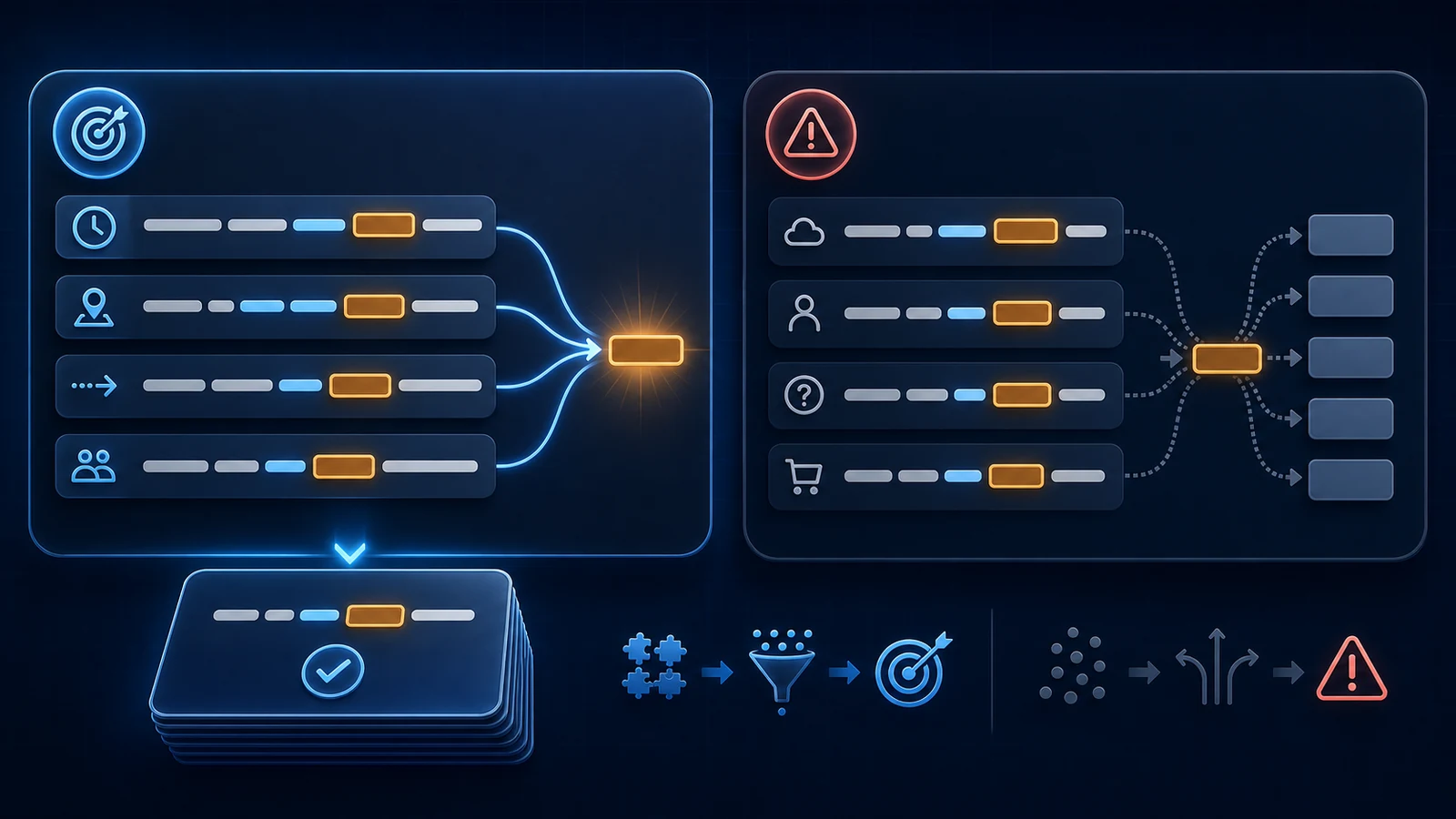
That is narrower than “turn every new word into a blank.” A good Cloze card tests a relationship inside a sentence. A weak one tests whether you can guess among several equally natural answers.
When to use Anki Cloze cards
Use a Cloze card when all three conditions are true:
- The sentence itself is the most useful prompt.
- One hidden span represents the learning target.
- The visible context makes the intended answer reasonably specific.
| Strong Cloze target | Why it works |
|---|---|
| Verb inflection | Subject, time, and surrounding grammar constrain the form |
| Preposition or particle | The expression is learned as a relationship, not an isolated definition |
| Fixed collocation | The visible half cues the phrase you want to retrieve |
| Gender or case ending | The sentence supplies agreement information |
| Short grammar pattern | One form completes a familiar structure |
Prefer a Basic recognition card when your goal is to understand the whole sentence. Prefer a listening card when sound is the prompt. Prefer a production card when you want to say an expression from a specific situation. Use the Anki Basic vs Cloze decision guide for a side-by-side example, then the parent Anki card-template guide for the broader set of retrieval jobs.
Create a Cloze note step by step
Anki treats Cloze as a special note type. The official Cloze documentation recommends cloning the existing Cloze type when you want to customize it; converting an ordinary Basic type does not give it the same card-generation behavior.
- In Anki Desktop, open Tools → Manage Note Types.
- Select Cloze, choose Add, and clone it with a descriptive name such as
Language Cloze. - Keep the built-in
Textfield andBack Extrafield. - Add optional fields such as
Audio,Source, orImageonly if they have a defined job. - In the Add window, select the new note type and write a natural target-language sentence in
Text. - Select the exact span to hide and choose the Cloze button. Anki writes syntax such as
{{c1::esperaba}}.
The number controls card generation. Two c1 deletions are hidden together on one card. A c1 and a c2 normally generate two sibling cards. That makes numbering a workload decision, not just formatting.
A copyable language-learning example
Text
No me lo {{c1::esperaba::verbo}}.
Back Extra
<div class="meaning">I wasn't expecting that.</div>
<div class="usage">esperarse algo — to expect something</div>
The optional verbo after the second pair of colons becomes a hint. Use a hint to identify the kind of answer—not to make recall automatic. “Verb” or “past tense” may be useful; the first letter plus the number of characters often gives away too much.
Front template
<div class="prompt">Complete the sentence</div>
<div class="sentence">{{cloze:Text}}</div>
Back template
<div class="sentence">{{cloze:Text}}</div>
<hr id=answer>
{{Back Extra}}
{{#Audio}}<div class="media">{{Audio}}</div>{{/Audio}}
{{#Source}}<div class="source">{{Source}}</div>{{/Source}}
The id=answer marker helps Anki scroll to the answer on long cards, especially on a small screen. Keep media references inside fields rather than constructing filenames in the template; the Anki field-replacement manual explains why dynamic media references can fail during import, export, and media checks.
Five Cloze examples for language learning
1. Verb form
Si tuviera más tiempo, {{c1::viajaría}} más.
The conditional clause constrains the verb form. Put the meaning and a one-line note about the conditional on the back.
2. Preposition
Depende {{c1::de}} la situación.
This tests the governed preposition as part of depender de, not a free-standing translation of “of.”
3. Separable or multiword expression
Ich {{c1::stehe}} jeden Morgen früh {{c1::auf}}.
Using the same cloze number hides both parts on one review. This is appropriate only when the two pieces form one target.
4. Agreement
La casa es muy {{c1::bonita}}.
The article and noun provide gender information. If the learner already knows the adjective, the card can focus honestly on agreement.
5. Collocation
Please {{c1::take}} your time.
The goal is the collocation take your time. A dictionary-style prompt such as “do slowly” would allow too many alternatives.
For cards mined from video, keep the original wording and a timestamp. The sentence-mining selection guide shows how to choose moments with one clear learning target before you add any deletion.
Avoid ambiguous and overloaded blanks
The most common Cloze failure is a sentence that accepts many answers:
Yesterday I {{c1::went}} to the store.
“Walked,” “drove,” “ran,” and “returned” may all be grammatical. Marking them wrong does not prove the learner forgot the target. Improve the card by adding meaningful context, testing a fixed expression, or changing the retrieval job to recognition.
Use this pre-save check:
- Specific: Does the visible sentence point to one intended response?
- Natural: Is this a sentence a proficient speaker could plausibly use?
- Focused: Is the hidden span one learning target?
- Diagnostic: Will a miss tell you what failed?
- Worth repeating: Is the form useful enough to justify future reviews?
Do not make separate c1, c2, c3, and c4 cards merely because four words are new. Each number can create another scheduled card. If four parts matter for different reasons, choose the strongest target now and revisit the sentence later only when the first card has proved useful.
Cloze is especially good for grammar—but not automatically
A language-learning community discussion about Cloze practice distinguishes constrained grammar examples from open vocabulary guessing. Learners report using Cloze for difficult grammar patterns and fixed relationships, while preferring other card types for words that can be prompted more directly. That practical distinction matches the card-design principle above: use context to test one relationship, not to hide arbitrary information.
Review, diagnose, and improve the card
During the first week, watch the reason you miss:
| What happens | Likely problem | Better fix |
|---|---|---|
| Several answers seem valid | Prompt is ambiguous | Add real context or switch to recognition |
| You solve it from grammar without knowing the phrase | Context is too revealing | Hide a different span or use listening |
| You remember the sentence shape, not the language | Card has become a visual pattern | Add varied examples; retire redundant cards |
| The answer is correct but spelling is weak | Retrieval is useful but feedback is too loose | Add a deliberate typed-answer card |
| Reviews multiply unexpectedly | Too many cloze numbers | Keep one target or suspend low-value siblings |
If exact spelling or accents are the actual skill, follow the separate Anki “type in the answer” setup. Do not add typing simply to make every review feel harder; it changes what the card measures and usually slows the session.
Keep audio on the back for most fill-in-the-blank cards so it verifies the answer instead of revealing it. If listening is the main task, make audio the entire front in a separate card type. The audio-and-image card guide explains that division.
The durable rule is simple: one natural sentence, one constrained deletion, one reason the answer matters.
Anki Cloze FAQ
Are Cloze cards good for language learning?
Yes, when the visible sentence strongly constrains one missing form, particle, ending, or collocation. They are weaker when several answers fit or when your goal is simply to understand the sentence.
How many Cloze deletions should one note have?
Start with one learning target. Reusing the same number hides connected spans on one card; different numbers usually generate sibling cards and add scheduled reviews.
Can an Anki Cloze include a hint?
Yes. In {{c1::viajaría::conditional form}}, the final text becomes a hint. Make it identify the answer type without revealing most of the answer.
Can I type the answer on a Cloze card?
Yes. Clone Anki's built-in Cloze note type and add {{type:cloze:Text}} to both sides. Use it when exact spelling or form is part of the goal.
Related guides
Anki Card Templates for Language Learning: 4 Copyable Layouts
Compare four copyable Anki card templates for language learning, choose by retrieval goal, install safely, and test HTML, CSS, media, and mobile layouts.
Read article →Anki Type in the Answer for Language Learning
Set up Anki type-in-the-answer cards for spelling, inflections, and Cloze prompts, with copyable templates, comparison behavior, and mobile checks.
Read article →Sentence Mining With Anki: Examples, Template, and Checklist
Learn how to sentence mine with Anki: choose one-target sentences, see a complete card example, use a practical template, and control review load.
Read article →