
Workflow
What Is Sentence Mining? A Practical Beginner's Guide
Learn what sentence mining is, how one useful moment becomes a focused Anki card, what to save, and how to avoid turning immersion into data entry.
Sentence mining is the practice of collecting useful sentences you encounter in real material and turning selected examples into something you can revisit. Some learners keep a notebook; others create Anki cards with the sentence, meaning, audio, image, and source.
The important word is selected. Sentence mining is not the automatic conversion of every subtitle line into a deck.
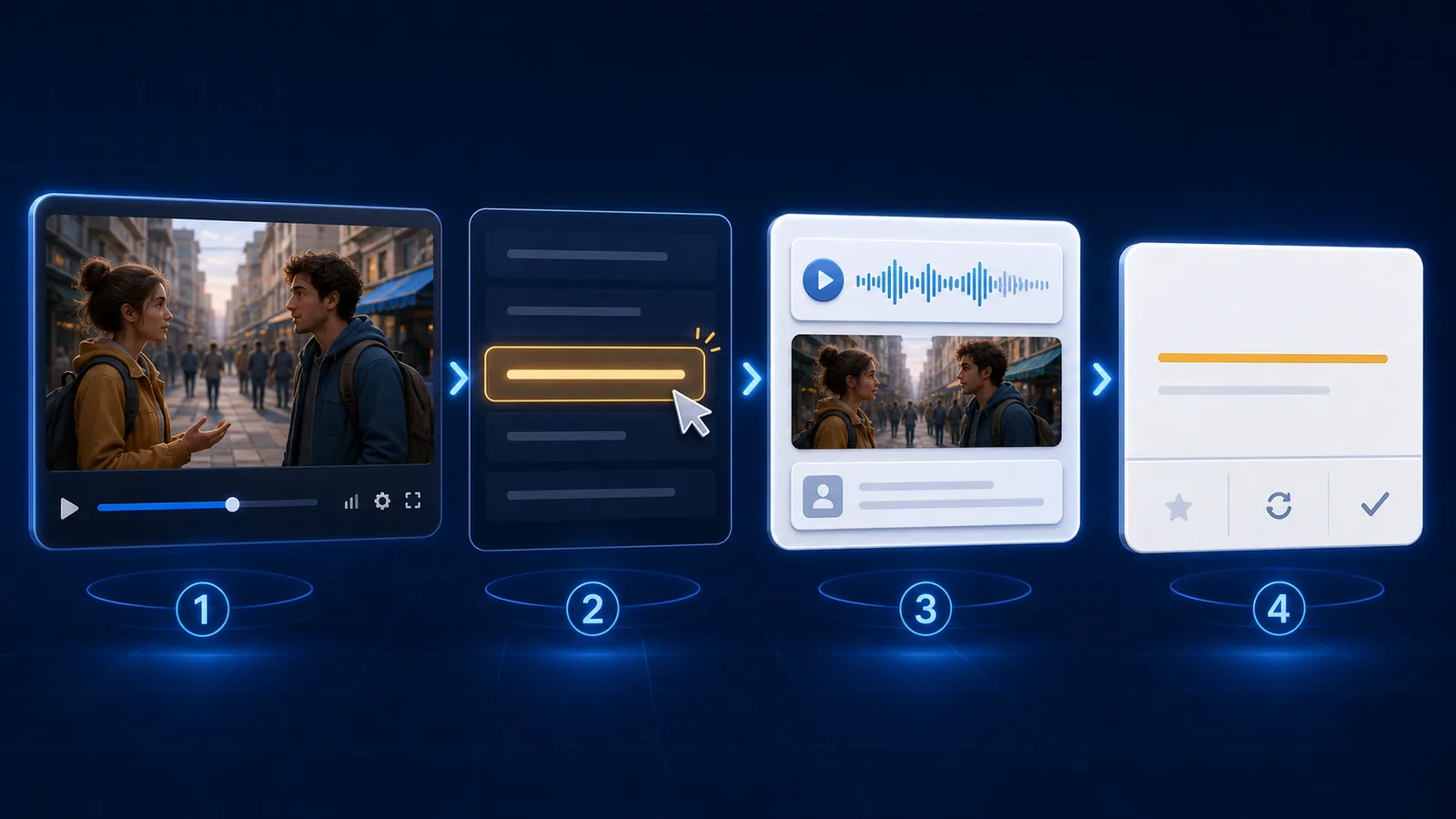
Sentence mining in one minute
A practical sentence-mining loop looks like this:
- Encounter a sentence while reading, listening, or watching.
- Decide that one expression, form, or sound is useful.
- Confirm what the sentence means in that context.
- Save enough evidence—text, audio, image, and source—to verify it later.
- Create one focused prompt.
- Let review results tell you whether to improve, suspend, or delete it.
The sentence supplies relationships that an isolated word may hide: which preposition follows a verb, how a phrase changes register, where emphasis falls, and what a pronoun refers to.
Sentence mining is not a particular app, browser extension, or note type. Tools can reduce capture work, but the learning decision remains which sentence deserves future attention and what the card should ask.
The basic workflow
Step 1: consume material for meaning
Watch or read with the actual content as the goal. If capture interrupts every few seconds, mark promising moments and return after the episode, chapter, or short segment. The two-pass video workflow protects immersion by separating watching from card production.
Step 2: identify one target
Ask why you stopped:
- an expression would be useful in conversation;
- a grammar pattern became clear;
- the audio sounded different from the spelling;
- a familiar word had a new contextual meaning; or
- the scene made a phrase memorable.
Write that reason in a few words. If you cannot, the sentence may belong in a reference notebook rather than the review queue.
Step 3: verify the example
Check the transcript against the audio. Confirm speaker, negation, inflection, and word boundaries. Use a reliable dictionary or grammar source for the specific uncertainty. Automatic captions and AI suggestions are drafts, not evidence.
Step 4: preserve the source
For video, store a title and timestamp. Keep the smallest complete audio unit that preserves natural boundaries. Add one scene image only when it supports context without revealing the answer.
Step 5: design the card
Choose the retrieval:
| Goal | Front | Back |
|---|---|---|
| Understand written language | Sentence | Meaning, focus, optional media, source |
| Recognize speech | Audio | Transcript, meaning, source |
| Supply one form | Constrained Cloze | Full sentence and brief note |
| Produce an expression | Specific situation | Target phrase, example, audio |
The complete sentence-mining-with-Anki guide includes a field layout and quality checklist.
What makes a sentence worth mining
A good candidate is:
- mostly understandable without a paragraph of explanation;
- focused on one learning target;
- natural for the speaker and situation;
- recoverable through a source or timestamp;
- clear in audio if listening matters; and
- useful enough to justify repeated reviews.
The popular “i+1” shorthand describes a sentence that is comprehensible except for one main new element. Treat it as a selection heuristic, not a mathematical rule. A sentence can contain two unknown surface words but express one clear pattern; another can contain one unknown word whose context remains hopelessly ambiguous.
Use the five-part sentence filter when you need concrete accept/skip examples.
Common beginner mistakes
Mining too early in the viewing session
Stopping at every unknown phrase turns listening into administration. Mark first, process later.
Saving every subtitle
A transcript is a reference resource; a review deck is a commitment. Whole-transcript conversion creates cards before value, accuracy, and review cost have been judged.
Treating the translation as the learning target
Translations verify meaning but rarely preserve every nuance. Keep the original sentence central and use a translation as contextual feedback.
Adding every card direction
Recognition, listening, Cloze, and production are different tasks. One note may hold all fields while generating only the card you need.
Keeping cards forever
A sentence that is now obvious, inaccurate, or irrelevant does not earn permanent review. Edit, suspend, or delete it.
Sentence-mining FAQ
What is sentence mining in language learning?
It is the selective practice of saving useful sentences found in real material and turning them into examples or flashcards you can revisit.
Do I need Anki?
No. A notebook or searchable example bank can work. Anki is useful when you want selected sentences to return on a schedule.
Should I mine every unknown sentence?
No. Choose sentences that are understandable enough to learn from, contain one useful target, and deserve future reviews.
Related guides
How to Set Up an Anki Sentence-Mining Deck in 5 Steps
Build a sentence mining Anki deck with seven fields, focused front/back templates, tags, CSV or APKG structure, and a five-card setup test.
Read article →Sentence Mining With Anki: Examples, Template, and Checklist
Learn how to sentence mine with Anki: choose one-target sentences, see a complete card example, use a practical template, and control review load.
Read article →How to Choose Sentences for Sentence Mining
Use a five-part filter to choose understandable, useful, one-target sentences with clean context and avoid low-value cards that inflate reviews.
Read article →Sentence Mining vs Vocabulary Decks: Which Should You Use?
Compare sentence mining and isolated vocabulary cards across speed, context, ambiguity, audio, review cost, and beginner usefulness.
Read article →