
Workflow
How to Review Sentence-Mining Cards in Anki: Daily Guide
Review sentence-mining cards with honest grading rules, quick card repairs, leech handling, audio-first checks, and a sustainable 15-minute routine.
Review sentence-mining cards by testing one defined skill, attempting the answer before you reveal it, and grading the result you actually produced. Use Again for a failed recall, Hard for a correct but doubtful recall, Good for a correct answer that took some effort, and Easy only when the answer was immediate. If you cannot grade a card fairly, repair or suspend the card instead of blaming your memory.
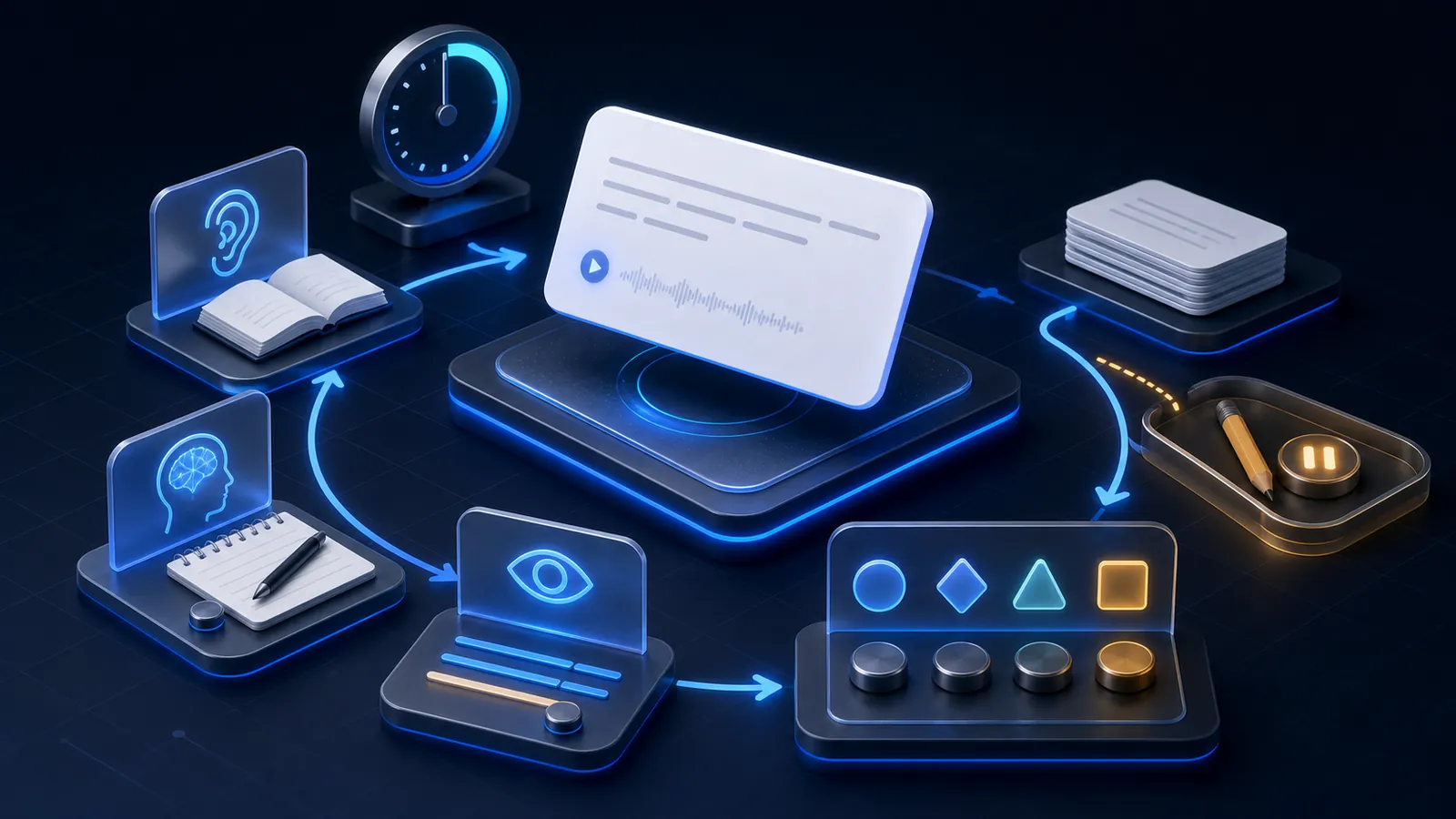
Decide what each card is testing
Before the first review, finish this sentence: "This card is successful when I can..." The ending should describe one observable action.
- Reading recognition: understand the sentence in context without translating every word.
- Listening recognition: understand the audio before seeing the transcript.
- Focused recall: supply one hidden form, particle, ending, or collocation.
- Guided production: say a target expression from a bounded situation or meaning cue.
Recognition is not failed production. If a reading card asks whether you understand Llevo dos años estudiando español, you do not need to reproduce the Spanish word for word. If the prompt asks you to express "I have been studying Spanish for two years" with llevar + time + gerund, then producing the construction is the task.
Mixing those standards makes ratings arbitrary. It also turns easy recognition cards into surprise translation tests. If you are unsure which job a note deserves, compare sentence mining with vocabulary decks and make the prompt match the reason you saved the language.
Use the same five-step review sequence
1. Read or listen once
Give the front your full attention. For an audio-first card, keep your eyes away from any transcript and listen once at normal speed. Replay once only when replaying is part of the standard test, not as an automatic rescue.
2. Make a specific attempt
For recognition, briefly state the contextual meaning or picture the situation. For a Cloze card, say the missing form. For production, say the target phrase aloud. Do not settle for "this looks familiar." Familiarity is evidence that you have seen the card, not that you retrieved its target.
3. Reveal before you start bargaining
If nothing useful comes within roughly ten seconds, show the answer. The official Anki studying guide recommends moving on rather than continuing to struggle after about that point. A quick failure gives clearer feedback than a thirty-second chain of guesses.
4. Compare only against the declared goal
Ask: Did I retrieve the target, was the meaning correct in this context, and did I avoid a material error? Ignore harmless wording differences on an open recognition card. Be strict about the exact form when that form is the stated target.
5. Grade, then keep moving
Choose the button that describes the recall. Do not choose the interval you wish the card had. If the card itself prevented a fair decision, flag it for repair and continue the session.
Choose Again, Hard, Good, and Easy honestly
Anki's buttons are memory judgments, not difficulty settings. Its official answer-button definitions make Again a failure and the other three passing grades.
| Button | Use it when | Sentence-mining example |
|---|---|---|
| Again | You could not recall the target, or your answer would fail outside Anki. | You understood the topic but missed the expression the card was built to test. |
| Hard | Your answer was correct, but slow or doubtful. | You recovered the exact particle after hesitation without revealing the back. |
| Good | Your answer was correct with normal mental effort. | You understood the sentence and its target meaning on the first honest attempt. |
| Easy | The correct answer came immediately with no mental effort. | The audio and target were instantly clear, with no reconstruction. |
Do not press Hard when you forgot: Hard is a pass. Do not press Again because a correct answer felt untidy, or Easy to push an annoying card away. If four choices create indecision, the manual explicitly permits a simple Again-for-incorrect, Good-for-correct approach.
Repair ambiguous or weak cards
A recurring miss can be a memory problem, but an ungradeable review is usually a card-design problem. A prompt such as "Say: I forgot" allows many valid translations. A long sentence with three unknown constructions cannot show which one failed. A screenshot that reveals the noun may make recall unnecessary.
During review, use a flag or mark and move on. After the due queue, give the card one of four treatments:
- Edit: name one target, correct the transcript, tighten the meaning, trim the audio, or move a revealing hint to the back.
- Split: keep the best target and make a separate card only if the second target is independently valuable.
- Suspend: remove the card from review until you can fix it or until its prerequisite is stronger.
- Delete: remove material that is low-value, duplicated, or not worth future time.
Anki's study screen supports editing and suspending a card or note; suspension hides it until you manually unsuspend it. Use the card-design checklist when the fix is not obvious.
Treat leeches as a diagnostic
A leech is a card you keep forgetting. By default, Anki marks the note with a leech tag and suspends the card when its lapse counter reaches eight; the threshold and suspend behavior are configurable. The official Anki leech guide recommends changing the presentation, deleting unimportant material, or leaving interfering material suspended until later.
For sentence cards, inspect the failure pattern:
- If several answers are reasonable, bound the prompt.
- If the target is buried in a paragraph, shorten the card.
- If two similar forms interfere, suspend one and learn the contrast deliberately.
- If the sentence is still opaque after explanation, return to easier input.
- If the language no longer matters, delete it without guilt.
Repeatedly pressing Again on the unchanged card is not repair. The leech signal exists to protect your review time.
Review audio-first cards without reading first
An audio-first card succeeds when you understand the sound, not when the back's spelling explains it. Listen once, state the meaning, then reveal the transcript. On a miss, diagnose whether you lacked the word, failed to segment connected speech, or had a bad clip.
Replay can answer a useful secondary question: "Would I understand this on a second hearing?" But grade against the rule you chose in advance. If first-pass comprehension is the target, second-pass success does not erase the first miss. If the clip starts late, ends early, or contains too much dialogue, edit it rather than creating an artificial listening failure. The audio-first card guide covers prompt placement and repair in more detail.
Use a 15-minute daily routine
| Time | Action | Rule |
|---|---|---|
| 0-2 min | Open the deck and scan the due count. | If reviews are overdue, introduce no new cards. |
| 2-12 min | Review due cards with the same sequence. | Attempt, reveal, grade; flag defects instead of editing mid-flow. |
| 12-14 min | Repair the highest-cost flagged cards. | Edit, suspend, or delete; do not rescue everything. |
| 14-15 min | Set tomorrow's intake. | Add only what this review pace can absorb. |
The exact minutes matter less than the boundary between reviewing and card maintenance. Keeping them separate prevents every confusing card from turning a short session into a research detour.
You are probably adding too many cards when due reviews regularly exceed the time box, yesterday's new cards dominate today's session, you keep postponing immersion to clear Anki, flags accumulate faster than you repair them, or you press Easy mainly to make cards disappear. Stop new cards until the queue is comfortable, then lower the intake. The per-video card-budget guide shows how to turn observed review capacity into a limit; better selection at capture time also helps, using the sentence-mining sentence filter.
Sentence-mining review FAQ
Should I say the whole sentence aloud during every review?
Only when production or pronunciation is the declared goal. For recognition, a correct contextual understanding is enough; forcing full production changes the test and slows the session.
When should I press Hard instead of Again?
Press Hard only after a correct but slow or doubtful recall. If you forgot the target or revealed the answer before retrieving it, press Again.
Should I delete every leech?
No. First decide whether the content is valuable and the prompt is fair. Edit a valuable weak card, suspend interfering material, and delete low-value or duplicated cards.
Related guides
How to Choose Sentences for Sentence Mining
Use a five-part filter to choose understandable, useful, one-target sentences with clean context and avoid low-value cards that inflate reviews.
Read article →Anki Card Design: 12 Best Practices for Language Learning
Design clearer language-learning Anki cards with one retrieval target, honest prompts, readable layouts, useful media, and sustainable card counts.
Read article →How to Make Anki Listening Cards for Language Learning
Build an audio-first Anki listening card with focused clips, separate transcript and meaning fields, copyable templates, and a practical review checklist.
Read article →How Many Anki Cards Should You Make From One Video?
Set a sustainable card budget for each video using your review capacity, card format, current workload, and the value of each candidate sentence.
Read article →